Monday, March 22, 2010

Back in Orbit

Forces of Inertia and Gravity have to be perfectly balanced for orbit to occur.

Revisiting the concept of orbital pathways... I came across some inspiring images:

From The British Journal of Photography 25, 2009. Untitled, Weimer, 1923-1925

Neckpiece by Iris Van Herpen from Oyster Magazine, Issue 79, 2009.

Saturn - From 'Heaven & Earth - Unseen by the Naked Eye' Phaidon Press Ltd. 2007
Bodysuit by Manish Arora. 

Gravity

A natural phenomenon, a fundamental interaction of nature that controls the existence of life as we know it. The equal forces of attraction and repulsion prevents collision and destruction of planetary masses. Similarly, clothing can literally be forces of attraction yet immediate boundaries that prevent the raw, physical closeness between human bodies. 


Celestial Mapping

A continuation of conceptual research must develop before the design process can begin.

Constellations come from our human tendency to draw imaginary lines between objects to create familiar shapes that we can recognize... essentially, it is our attempt to make sense of the immeasurable vastness that is our universe.


Mapping and plotting are concepts that can transfer to pattern making and garment construction. Essentially, a pattern is a mapped area that corresponds to coordinates of the body to create a familiar shape such as a sleeve or collar. 


Orbital


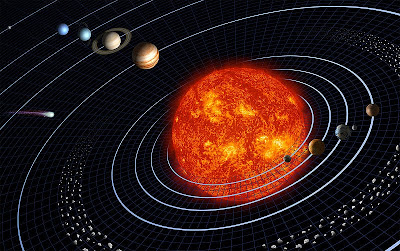
In celestial mechanics, an orbit is the gravitationally curved path of an object around a central point. 'Orbiting' and the orbital path of planets in our solar system is a central focus of my concept, used as inspiration to develop shape, form and silhouette in design. 

Above: This illustration is from Kepler's 'Astronomia Nova' - published in 1609 
It shows the orbit of Mars from Earth's perspective.

Above: A diagram of the same orbital path of Mars from Earth's 
perspective produced with the modern computer program 'Sirius'.

Planet Mandalas are a visual representation of the movement of different planets in orbit. The computer program 'Sirius' maps these orbits to create an image that essentially connects astronomy and art. 


Concept Development and Colour Direction:

Below is a rough 'concept board' I made to communicate my inspiration and concept angle.

Orbiting spheres controlled and directed by gravitational forces

Above: Colour Board

Above: Accent Colour Board 

Sunday, March 21, 2010

Wandering Stars


Neptune - From 'Heaven & Earth - Unseen by the Naked Eye' Phaidon Press Ltd. 2007

As humans, our obsession with the night sky is ancient and modern. Regardless of impressive advances in technology that has resulted in knowledge of our universe, there remains a mystery and intrigue of the unknown that is both inspiring and frightening. 

The word 'planet' comes from the greek term '
πλάνητες ἀστέρες' meaning 'wandering stars'. Ancient Greek astronomers noticed that certain lights moved about the night sky in in comparison to other stars, and thus the poetic term 'wandering stars' was born. 

All pre-modern societies believed the stars and planets circled the Earth, and the Earth was the centre of the universe. 

Printed rendition of a geocentric cosmological model from Cosmographia, Antwerp, 1539 

From a design perspective,  the concentric rings of this model immediately appeal to me. The gradual, circular and repetitive visual elements reflect the planetary movements of what was once thought to be undisputed knowledge: Geocentricism - the Earth at the Centre of the Universe. 

Above: Illustration of the Ptolemaic (Geocentric) system of astrology. By Andres Cellarius, 1660.

In the Geocentric model, the Earth was believed to remain totally still whilst the planets, stars and sun circled it

Above: Geocentricism was overthrown by Helioentricism in the 16th Century. 
Copernicus and Galileo discovered that the planets circled the sun. ('Helios' meaning 'Sun' in Greek)

 Above: The Greek astronomer, philosopher and mathematician Aristarchus of Samos [ circa 310 B.C. - 230 B.C. ] first proposed a heliocentric model of the universe about 1,700 years before Copernicus. He is best known for his pioneering attempts to determine the sizes of and distances to the moon and sun. 

The sheer antiquity of this curious nature we possess to understand our universe is of great interest to me. These diagrams show humanity's development of the knowledge of our existence on here on Earth. Although basic in geometric shape and form, the development they signify is far from the previous beliefs of geocentricism and the idea that the Earth was flat. 

The models (above) show my initial inspiration in terms of shape, form and silhouette in design. To continue and expand, however, research into planetary orbits is the next step. 

Sensory bright, Infinite dark.


The purchase of my new favourite book 'Heaven & Earth - Unseen by the Naked Eye' (Phaidon Press inc. 2007) saw the beginning of my obsession with with images of space. Simple and out-dated  it may seem, space does not cease to amaze and inspire me. 

With sensory brights and infinite darks, it is not just the celestial colours and organic shapes that appeal...these images show the beauty of the vast unknown of the universe. To me, they are a reminder of the scientific miracle this is life and the chance occurrence that is our existence here on Earth. 

Rather than referencing past eras or designers as inspiration for my final collection, I am inspired by science and scientific thought. Despite the fact that I am definitely not a scientist (although I did complete just one year of a medical science degree) I believe science can present a deeper perspective on the familiarities of daily existence. 


Saturday, March 20, 2010

It began in Africa


This blog will track the development of my graduate collection project  for the final year of my degree in Fine Arts - Fashion at QUT, Brisbane QLD. 

Like our ancestors, my initial inspiration for my final year collection came from Africa. Going 'tribal' with geometric brights and animals prints was not my angle, but rather something a little more obscure: Voodoo. 

To many, the word ‘Voodoo’ may conjure up images of sticking pins into dolls or casting evil curses on your enemies using black magic and sorcery. However, this is not a true representation of what Voodoo is about.

Voodoo, meaning ‘spirit’ developed from what is considered to be the world’s most ancient, ancestral, nature honouring traditions coming from Africa. The belief is in a single divine creator and a cascading hierarchy of spirits called ‘Vodun’ that control the forces of nature and human society. 

Visual inspiration appeared in the form of Veve: ritual diagrams drawn during the Voodoo ceremony, believed to harness planetary powers and oblige a Voodoo spirit to descend to earth to possess the body of the Voodooist. 

Here are some examples of Voodoo Veve:


Visually, these primitive diagrams were inspirational in terms of form, symmetry, geometry and symbolism. Symbolism being the key aspect here, as I am very interested in the Voodoo belief that these Veve's are representations of astral forces and essentially act to harness planetary powers to affect mortal human life.

Originally, my final collection was to be inspired by eight of these Veve's and the spirit each one represents... to be translated into individual garments or 'outfits'. I soon realised, however, that my interest seemed to stray from Voodoo and become focused on human's ancient 'obsession' with the planets and stars. 


Moon And Stars - Photograph by Gale Cochrane-Smith
The sun, planets and stars were worshipped as Gods and Goddesses for centuries. Constellations were (and still are) used to explain personality traits of people born at certain times of the year. Astrology and Astronomy have roots in ancient Greece, China, India and most civilizations throughout history. 


The Sun:
Our light and our lives.
The creator and eventual destroyer of life.

For millions of years, the sun was as close as we got to staring into the face of God. Worshipped throughout history for its life-giving powers, the sun's familiar presence in the sky is life itself as we know it.

Planets, stars and the immeasurable vastness of our universe is so deeply intriguing and mystifying... a hold on humanity that will never fade. This idea is what will form the basis of my final collection this year.